
Full bespoke CRM · Project 02
SCOOBY
A complete CRM built around the day-to-day work of a small housing charity.
- Client
- A small housing charity
- Type
- Secure multi-user CRM
- Status
- Live, staff login only
The awkward bit
What needed to change.
Generic housing software was too large and too rigid. Information was spread across different places, and getting a reliable view took too long.
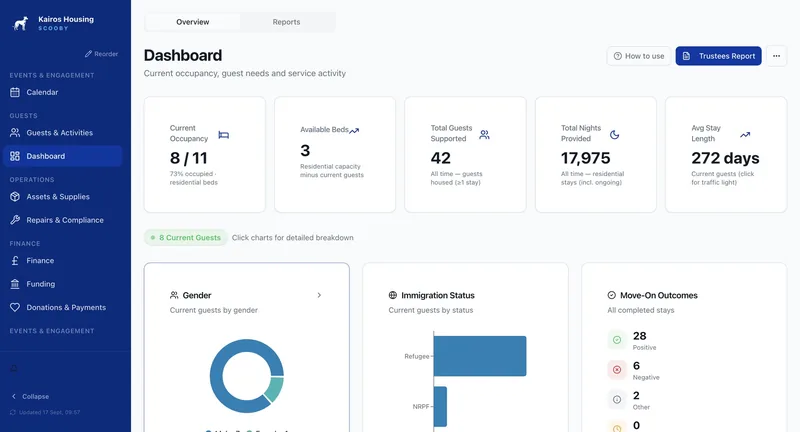
One bespoke CRM shaped around the charity: referrals, residents, stays, properties, rooms, casework, repairs, compliance, payments, donations and reporting.
The result
A job that used to take a month can now be completed in minutes.
How it works
Simple on the surface. Thought through underneath.
- 01
The system follows the charity’s real process from referral through a person’s stay and move-on.
- 02
Teams can see the work they need without navigating a system designed for a much larger organisation.
- 03
Dashboards and reports turn live operational records into information the organisation can use.
The full story
Why it was built this way.
What the work looked like before
The charity was not short of information. It was short of one place to put it. Referrals arrived one way, resident records lived somewhere else, property and repair details sat apart from both, and finance kept its own version of events.
Each of those had grown up for a good reason, and each worked well enough on its own. The difficulty only appeared when somebody needed to see across them. A question as ordinary as who we are supporting right now, and what is outstanding for them, meant opening several things and assembling the answer by hand.
That is the quiet cost of software that almost fits. Nobody is doing anything wrong, and nothing is visibly broken. The work simply takes far longer than it should, and the answer is only ever as current as the last person to update it.
Why bespoke was the right answer here
We looked at what could be bought first, because usually that is the cheaper and faster route. For many charities an existing product is the right call, and we say so when it is.
The problem in this case was the shape of the work rather than the size of it. Housing management products handle tenancies and properties well. Case management products handle support work well. This charity does both at once, and adds repairs, compliance, payments and donations to the same daily picture.
Buying two products would have meant running two systems that did not talk to each other, reconciling them by hand, and paying for large sections that neither team would ever open. The gap between the products was exactly where this charity does its work.
What we built
One system that follows a person from referral, through their stay, to move-on, as a single continuous thread rather than a set of separate records.
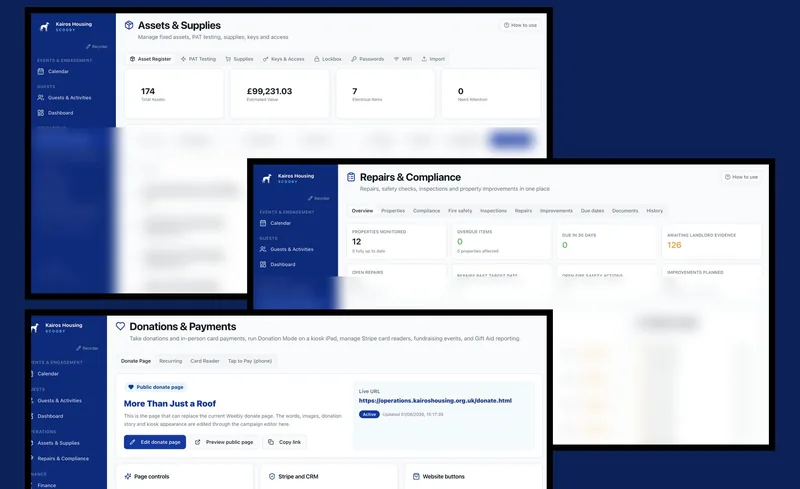
Around that sit the practical things a supported housing charity has to stay on top of: properties and rooms, repairs and their progress, compliance dates that must not be missed, and the payments and donations that need to be visible alongside the operational picture rather than in a separate world.
Permissions were designed at the start rather than added afterwards, so staff see what their role needs and no more. Reporting was treated as part of the system from the beginning, because the reports were the thing taking the longest.
What actually changed
The headline is the reporting. Work that used to be assembled over about a month is now produced in minutes, because the system is reporting on live records instead of asking somebody to rebuild the picture from several places.
The less dramatic change matters just as much day to day. Information is entered once. Staff stop holding the full picture in their heads or in a personal spreadsheet, and managers, trustees and funders can be given a current answer rather than a reconstructed one.
At a glance
- One shared CRM
- Housing and casework
- Repairs and compliance
- Useful reporting
Common questions
What people ask about this.
- Why build a bespoke CRM instead of buying one?
- Only when an existing product genuinely does not fit. Here the charity delivered both housing and support work, and the available products covered one side or the other. Buying two would have meant two systems that did not talk and a reconciliation job by hand. Where an affordable product does fit, we will tell you.
- Can a bespoke system replace spreadsheets and separate databases?
- That is usually the aim. We start by understanding what each spreadsheet or database is actually doing, because some are carrying more than they appear to. Then we decide what belongs in one reliable system and what can be retired.
- How is sensitive information handled?
- Access, permissions, data handling and backups are agreed at the start rather than bolted on later. The system is designed so that people see the information their role requires, with those responsibilities settled before launch.
- Could a smaller charity have something like this?
- Yes, and usually it should be smaller. A system like this one is broad because the charity is. A focused system covering one awkward process commonly starts around £3,000, and it is often better to build that first and extend it once it is earning its place.
Have an awkward process of your own?
Tell us how it works now. We will help you see what a simpler version could be.
Start the conversation