01
Referrals and enquiries
Bring new requests into one clear process and make the next action visible.
Bespoke CRM for small charities
One clear place for referrals, people, casework, tasks and reporting — without forcing a small team into software designed for a much larger organisation.
CRM in plain English
CRM stands for customer relationship management, but many charities are managing much more than customers. A useful charity CRM can connect a referral, a person’s support, staff actions, service outcomes and the information needed for reports. The name matters less than whether the system makes daily work clearer.
What it could bring together
01
Bring new requests into one clear process and make the next action visible.
02
Keep the records, notes, tasks and outcomes connected to the person receiving support.
03
Shape screens and workflows around the work your charity actually provides.
04
Track rooms, repairs, checks and responsibilities when housing is part of the service.
05
Record the financial activity the team needs to see alongside operational information.
06
Turn live records into useful information for managers, trustees and funders.
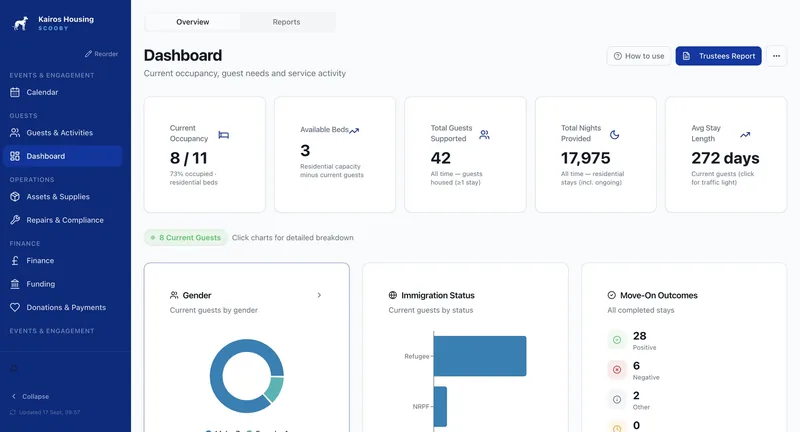
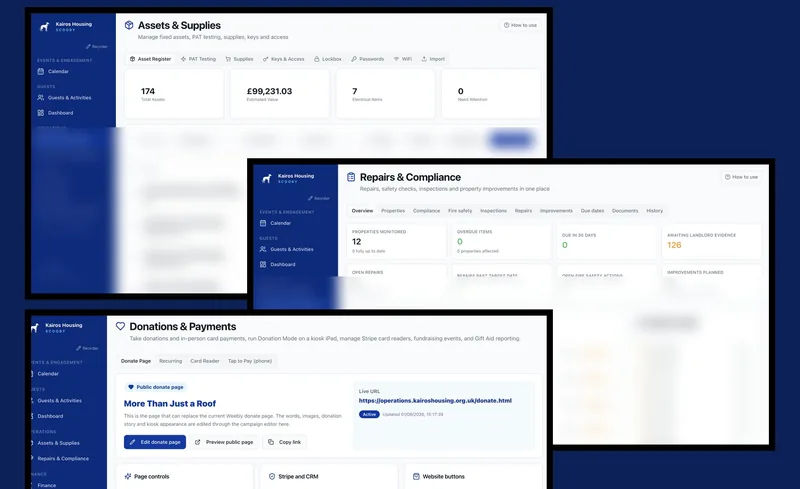
A complete charity CRM in daily use
A complete CRM built around the day-to-day work of a small housing charity.
“This has revolutionised our operation. It has turned a job that took a month into minutes.”
Chief Executive, housing charity
Read the SCOOBY case studyA straight answer first
Plenty of charities are well served by established fundraising or membership platforms. Buying one of those can be quicker and less expensive than commissioning new software.
Bespoke earns its place when the distinctive part of your service does not fit: staff retype information, maintain parallel spreadsheets, cannot see the whole picture or spend too long producing reliable reports. The first conversation is about that decision, not about selling the largest possible build.
Operational understanding
Stephen has worked in operational roles for charities and is a trustee of two charities. That experience helps the conversation begin with services, people, reporting pressure and limited team capacity — then work back to the software.
How the work begins
We look at the work as it happens, including spreadsheets and workarounds.
We agree what the first version must solve and what can wait.
Your team reviews working screens while changes are still straightforward.
Data, launch, training and ongoing responsibilities are agreed clearly.
Charity CRM questions
A charity CRM gives your team one shared place for the people, relationships and work the organisation manages. For a service-delivery charity, that can include referrals, casework, outcomes, properties, tasks and reporting as well as supporters or donations.
It makes sense when standard software leaves important gaps, creates repeated work or forces your service into the wrong process. If an affordable existing product fits well, we will say so.
Usually that is the aim. We first understand what each spreadsheet or database is doing, then decide what belongs in one reliable system and what can be retired.
Often, yes. The data needs to be reviewed before migration so old duplicates and inconsistent fields are not simply carried into the new system. Migration is scoped and priced before work begins.
Access, permissions, data handling and backups are discussed at the start. The system is designed so people see the information they need for their role, with responsibilities agreed before launch.
A focused system commonly starts around £3,000. A broader build depends on the number of workflows, users, reports, integrations and the condition of existing data. You receive a fixed scope and quote before development begins.
Focused systems typically start around £3,000
Bring the spreadsheets, repeated jobs and rough description. We will help work out whether bespoke software is sensible.
Start a free conversation